C.A.M. Al Wahi
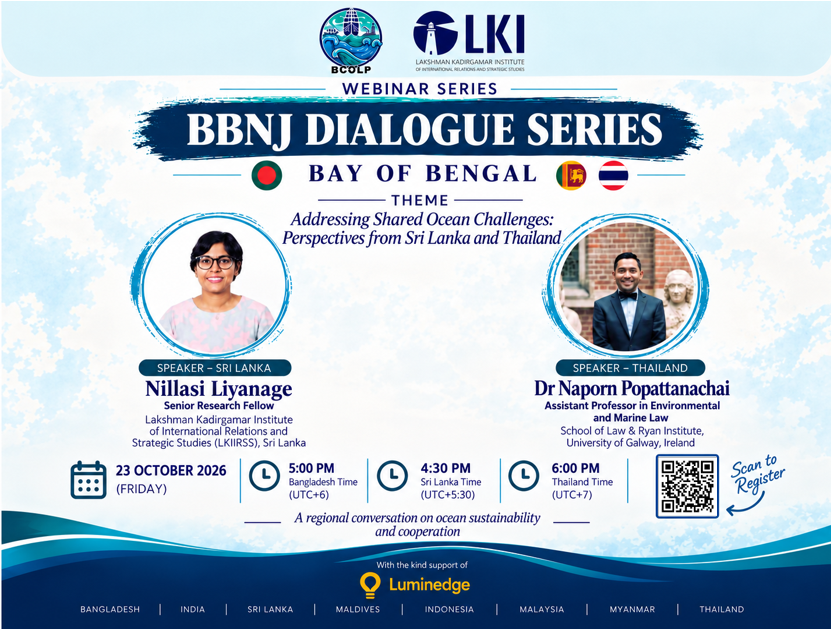
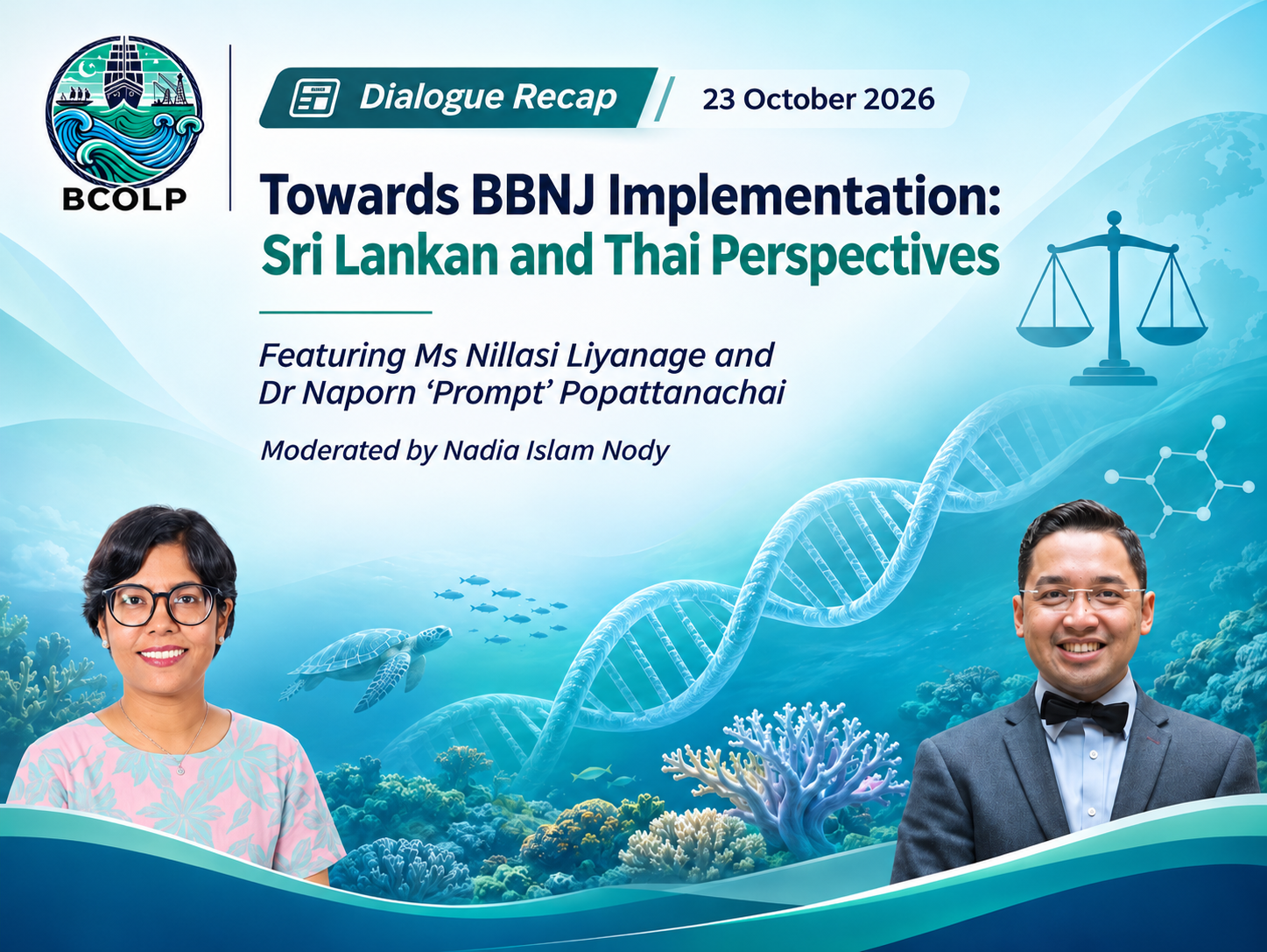
The Bangladesh Centre for Ocean Law and Policy (BCOLP) hosted the second episode of its BBNJ Dialogue Series on 23 October 2026, focusing on national preparedness, implementation priorities and regional cooperation under the Agreement on the Conservation and Sustainable Use of Marine Biological Diversity of Areas beyond National Jurisdiction (BBNJ Agreement).
The session featured Ms Nillasi Liyanage, Senior Research Fellow at the Lakshman Kadirgamar Institute of International Relations and Strategic Studies (LKI), Sri Lanka, and Dr Naporn ‘Prompt’ Popattanachai, Assistant Professor in Environmental and Marine Law at the University of Galway, Ireland. The discussion was moderated by Nadia Islam Nody, Assistant Professor in Law, Bangladesh Army International University of Science and Technology (BAIUST), Cumilla, Bangladesh.
The BBNJ Agreement entered into force on 17 January 2026, with its first Conference of the Parties (COP1) scheduled for 11–22 January 2027 in New York. The dialogue examined how developing countries are preparing to implement the Agreement and the opportunities for regional cooperation.
Sri Lanka’s preparations for BBNJ implementation
Ms Liyanage discussed Sri Lanka’s engagement with the BBNJ Agreement, including its participation in negotiations since 2018 and ratification in 2025.
She identified five principal implementation challenges: institutional coordination, updating domestic legislation, scientific and technical capacity, traditional knowledge, and partnerships with governments, regional organisations and technical experts.
Sri Lanka has established an inter-ministerial committee through a Cabinet Paper to identify implementation gaps and facilitate legislative measures. Four subcommittees address the Agreement’s main areas, while a fifth, covering legal, policy and institutional matters, has been proposed.
As a dualist State, Sri Lanka requires domestic implementing legislation. Ms Liyanage explained that the draft legislation is being developed with sufficient flexibility to accommodate future COP decisions and guidance from the Scientific and Technical Body.
She also highlighted LKI’s contributions, including its involvement in a five-day inter-ministerial workshop organised with Australian partners in 2026, a policy brief on BBNJ implementation, and proposals to strengthen research and information-sharing.
Ms Liyanage emphasised that effective implementation requires stronger institutional coordination, appropriate legislation, scientific capacity and regional cooperation.
Thailand’s perspective and emerging implementation challenges
Dr Popattanachai offered a broader assessment of the challenges developing countries may encounter. Thailand has signed the BBNJ Agreement, but its ratification remains pending.
Dr Popattanachai anticipated that COP1 would focus primarily on procedural and institutional arrangements, including rules of procedure, financial mechanisms and subsidiary bodies. Particular attention was drawn to proposed arrangements for cooperation between the BBNJ framework and existing international institutions.
Regarding marine genetic resources, Dr Popattanachai highlighted challenges associated with establishing the clearing-house mechanism, benefit-sharing arrangements and their interaction with intellectual property law. Developing countries would need both technical expertise and national systems capable of interacting with international mechanisms.
The discussion also addressed area-based management tools, including marine protected areas, and environmental impact assessments. Dr Popattanachai stressed the importance of coordination with existing regional institutions and the difficulties developing countries may face in adapting domestic environmental assessment systems.
Capacity-building emerged as a central concern. Dr Popattanachai suggested that developing countries establish inter-ministerial mechanisms to identify their collective needs and communicate them effectively to international partners and assistance providers.
Opportunities for Bay of Bengal cooperation
The question-and-answer session explored how developing countries could participate more effectively in BBNJ implementation, particularly in relation to marine genetic resources, technical assistance and international negotiations.
Both speakers agreed that joint proposals by Bay of Bengal States for marine protected areas could strengthen regional voices in international ocean governance.
The dialogue highlighted the importance of coordinated national institutions, scientific and technical capacity, and cooperation among developing countries as the BBNJ Agreement moves towards its first COP.
For BCOLP, the discussion provided valuable comparative perspectives on the opportunities and practical challenges facing Bay of Bengal countries in implementing the Agreement.