
Shah Maruf
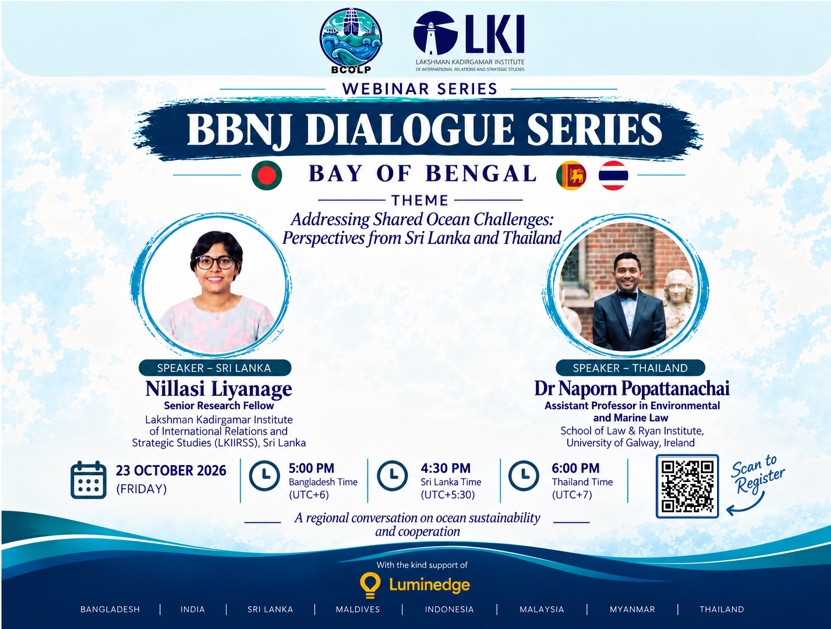
On 20 September 2026, the Bangladesh Centre for Ocean Law and Policy (BCOLP) hosted the first episode of its BBNJ Dialogue Series, featuring Professor Arie Afriansyah, Director of the Center for Sustainable Ocean Development at the Faculty of Law, Universitas Indonesia, as the keynote speaker. Professor Afriansyah discussed “Indonesia’s Leadership in Marine Conservation and Sustainable Ocean Governance”. The Dialogue Series aims to discuss the preparedness of Bay of Bengal countries for implementing the BBNJ Treaty ahead of the Treaty’s first COP in January 2027.
Drawing on his expertise in international ocean governance and his experience as a consultant on Indonesia’s implementation of the BBNJ Treaty, Professor Afriansyah discussed Indonesia’s national ocean governance, its BBNJ experience, and potential cooperation between Global South countries such as Indonesia and Bangladesh on BBNJ-related matters.
Professor Afriansyah discussed Indonesia’s marine governance challenges and opportunities, explaining how the ocean connects Indonesia’s islands while also presenting complexities relating to constitutional issues and the balancing of economic activities with ecosystem protection. He outlined four key governance components: conservation, sustainable use of fisheries, marine spatial planning, and science-institution connections, noting that while policies exist, they often do not work together effectively. The discussion highlighted how Indonesia’s experience could provide valuable insights for Bangladesh’s coastal management, particularly regarding coordination between domestic institutions and international agreements such as the BBNJ Treaty.
He then discussed marine conservation and management in Indonesia, focusing particularly on the Raja Ampat marine protected area (MPA). He emphasised the importance of proper governance and community involvement in managing tourism and fisheries. He also highlighted Indonesia’s participation in the Coral Reef Triangle Initiative and outlined the country’s blue economy policy, which includes expanding marine conservation areas, quota-based fishing, and sustainable aquaculture. He cautioned, however, that a comparative study of governance approaches would be more appropriate than directly copying Raja Ampat’s management model.
Professor Afriansyah lastly focused on the implementation of the BBNJ Treaty, highlighting Indonesia’s experience across its four main areas: marine genetic resources, area-based management tools, environmental impact assessments, and capacity-building. He emphasised the importance of coordination between ministries and institutions, noting that Indonesia established a National BBNJ Team (Timnas BBNJ) in 2026, led by the Minister of Fisheries and Ocean Affairs with a mandate until 2030. The establishment of the Team was a critical step towards consolidating inter-ministerial coordination, defining institutional roles, and ensuring coherent national inputs in future international fora.
He suggested potential opportunities for collaboration between Bangladesh and Indonesia, including exchanges on marine protected areas, research workshops, biodiversity data collaboration, and environmental assessment simulations.
The presentation was followed by a Q&A session in which participants discussed the transferability of Indonesian models to the Bay of Bengal region, the need for strong institutional frameworks, and challenges in integrating ocean law education into university curricula. Professor Afriansyah encouraged young researchers from the Bay of Bengal region to engage in BBNJ-related research and cross-border collaboration. He emphasised that Indonesia’s experience should be used for comparative studies rather than direct legal transplantation, while recognising that it could provide valuable insights for other countries in the region.
Dr Abdullah Al Arif, Director of BCOLP, moderated the session. The session concluded with a call to explore opportunities for collaboration between Universitas Indonesia and BCOLP, including the possibility of developing joint research proposals or exchange programmes covering four proposed areas: marine protected areas and fisheries exchanges, research workshops, biodiversity data collaboration, and environmental assessment simulations.
Shah Maruf is a Lecturer in Law at East West University. He is also an Executive Member of the Bangladesh Centre for Ocean Law and Policy (BCOLP) and the Editor of the BCOLP Blog. He can be reached at shah.ahmad@ewubd.edu.