Arron N. Honniball
Introduction
Bangladesh’s Territorial Waters and Maritime Zones (Amendment) Act, 2021 represents a concrete and commendable effort in giving domestic legal effect to the provisions of the United Nations Convention on the Law of the Sea (UNCLOS). It substantially amended the Territorial Waters and Maritime Zones Act, 1974, in particular, by updating and clarifying the definition of Bangladesh’s maritime zones and their delineation. These amendments followed significant intervening developments for Bangladesh’s maritime entitlements, including the adoption of the 1982 UNCLOS, the 2012 Bay of Bengal (Bangladesh/Myanmar) Judgment, and the 2014 Bay of Bengal (Bangladesh/India) Award.
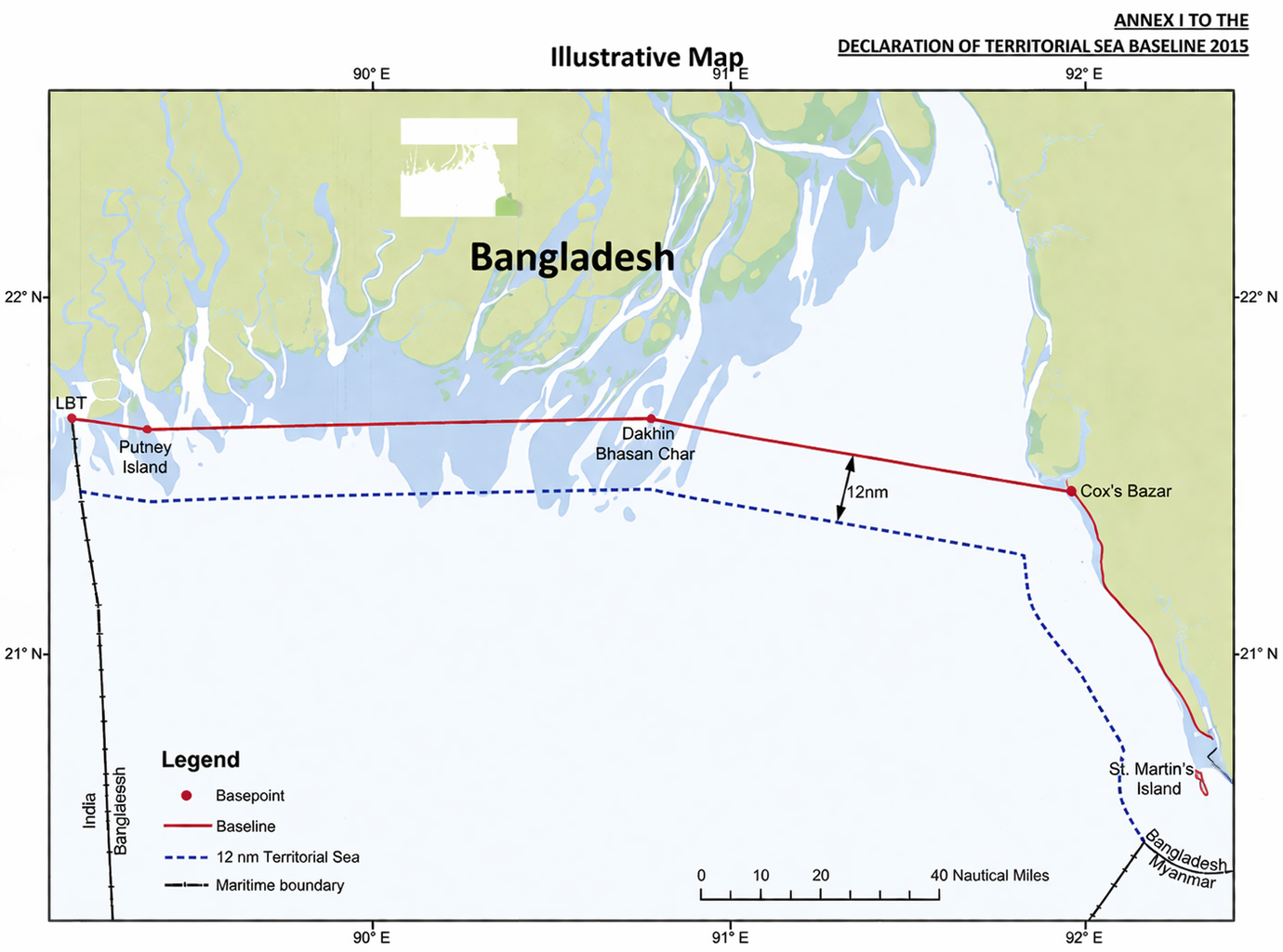
Commentators (Hosen; Al Wahi et al.; Mishra and Bashar) have therefore warmly welcomed the amended Territorial Waters and Maritime Zones Act (‘Act’). Indeed, insofar as addressing the maritime zones codified in UNCLOS, the Act is largely concordant with international law. The objections of neighbouring States do not concern the Act or delineated maritime zones themselves, but rather implementing practice which determines the exact baselines or basepoints, or suggests unilateral delimitation (e.g., India (2) and Myanmar (2)). However, this post focuses on where the Act goes beyond the maritime zones codified in UNCLOS, with the 2021 amendments empowering a Bangladeshi claim to “historic waters” under general international law. Section 2E of the Act now provides that the Government of Bangladesh may delineate “historic waters”, a claim previously unseen in both the 1974 Act and all implementing practice (2), including illustrative maps. Surprisingly, this addition has evaded academic scrutiny, and it is therefore worth exploring here how the Government might wish to respond to this empowerment to declare historic waters.
This post argues that the lawful establishment of novel ‘historic waters’ claims in the 21st Century is extremely challenging in international law, and therefore the addition of historic waters to the amended Territorial Waters and Maritime Zones Act is unfortunate and likely un-operational. A review of existing practices and the requirements to lawfully establish historic waters suggests that this new chapter should be swiftly closed, and no historic water limits should be established by Bangladesh. Existing entitlements and fixed baselines are already sufficient to address any concerns that might have inspired the inclusion of a historic waters option.
‘Historic Waters’ in the Amended Territorial Waters and Maritime Zones Act
Undoubtedly, the amendment and legal clarification of Bangladeshi maritime zones, as codified in UNCLOS, are of benefit to Bangladeshi stakeholders and neighbouring States. For example, the Bangladeshi internal waters and Bangladeshi territorial sea are now clearly distinguished and delineated (as opposed to the formerly obscure and outdated ‘territorial waters’ terminology) and the Bangladeshi exclusive economic zone is consolidated and delineated (as opposed to the former ‘economic zone’ and ‘conservation zone’). Both issues had only partially been addressed through secondary notifications that ‘interpreted’ the act while declaring baselines and maritime limits.
However, the rationale behind the addition of a historic waters option is not evident in the Act. Historic waters are defined in the Act as “the Internal Waters landward of the baseline that has been historically recognised as forming an integral part of Bangladesh” (Section 2(7)) and “the Government may, by notification in the official Gazette, specify the limits of waters adjacent to its land territory as the Historic Waters” (Section 2E). To date, it does not appear this provision has been operationalised, and no historic waters claim has been gazetted. The 2015 Notification of Baselines only refers to straight and normal baselines (para 1B). However, its author, Alam, has suggested in private academic writings that these are, in part, based on article 10(6) of UNCLOS concerning historic bays. This would conceivably only be in the east, between basepoints 3 (Dakhin Bhasan Char) and basepoint 4 (Cox’s Bazar). Still, no explicit historic bay or waters claim has ever been made by Bangladesh in law or practice – and likewise not protested by maritime States such as the USA (State Department, pp 10-12). This contrasts with other States in the Bay of Bengal, which have clearly asserted historic water claims (and faced U.S. protests), including Sri Lanka (Section 9) and India (Sections 8, 10) in the Palk Bay and Gulf of Mannar (see 1974 Agreement and 1976 Agreement).
Historic Waters: Looking Ahead
Looking ahead, the lawful proclamation of historic waters under Section 2E of the Act will be extremely challenging, principally due to the lack of historical practice to justify such an assertion. Historic waters are indirectly recognised by UNCLOS (Arts 10(6), 15 and 298(1)), but are principally governed by customary international law (Tunisia/Libya Judgment, para 100). As an exceptional departure from codified rules and standards, historic waters are restrictively interpreted and applied. The burden of proof rests on the claimant State(s) who must, at a minimum, fulfil three conditions to acquire a historic title:
- The authority exercised over the area by the State, claiming it as historic waters;
- The continuity of such exercise of authority;
- The attitude of foreign States.
These factors are well established, as summarised by a UN Secretariat Study and affirmed in the South China Sea Award (para 222). As an exceptional right, “[t]hey accord a right that a State would not otherwise hold, were it not for the operation of the historical process giving rise to the right and the acquiescence of other States in the process” South China Sea Award (para 268).
In abstract, a Bangladeshi claim is limited to internal waters landward of its baselines. This would suit the normal circumstances of historic waters, which only concern maritime areas close to shore where authority could have been asserted. However, there is no indication that the “historical process” has been initiated. Waters historically recognised as forming an integral part of Bangladesh have not been identified, let alone subjected to continual Bangladeshi authority and agreed to by other States in the process. Apart from the aforementioned lack of appearance of any ‘historic waters’ practice before the 2021 amendments, it is difficult to see how this process could be successfully initiated in the 21st Century.
Indeed, to the contrary, Bangladesh was the leading authority that crafted and successfully negotiated the adoption of article 7(2) of UNCLOS concerning straight baselines in the context of highly unstable coastlines, including deltas (Trümpler, para 34). Article 7(2) of UNCLOS was “drafted with the specific case of the Ganges/Brahmaputra River delta in mind” (Nordquist/Nandan/Rosenne, para 7.9(c)). Finally, while the tribunals in the Bay of Bengal (Bangladesh/Myanmar) Judgment (para 129), and the Bay of Bengal (Bangladesh/India) Award (para 227) were not tasked with delimiting internal waters, both noted a lack of claim to – or evidence of – historic title in the maritime areas under dispute.
A shift by Bangladesh towards claiming a historic bay or other historic waters would be a significant departure from previous practice and leadership. Given the existing objections to certain Bangladeshi straight baselines as being excessive (Roach, p 120), it cannot be expected that the attitude of foreign States to a historic waters claim measured landward from said baselines would be positive. A claim to historic waters would therefore not provide any additional or persuasive support to the legality of excessive baselines, including the excessive breadth of internal waters thereby enclosed. If the baselines should retreat landward, so too must the Bangladeshi internal waters. A retreating UNCLOS article 8-based internal waters claim cannot simply be replaced by a novel historic waters-based internal waters claim when the three conditions to acquire a historic title have not been met. Note, Bangladesh has likewise objected to the straight baselines of neighbouring States it considers excessive (e.g. India, Myanmar (para 3.14)).
Finally, here retreating baselines and internal waters only refers to the replacement of excessive baselines with compliant baselines and the consequences this will have on delineating maritime zones from those baselines. Existing and lawfully established baselines, geographical coordinates and outer limits of maritime zones (duly deposited with the UN Secretary-General) may be lawfully preserved by Bangladesh under UNCLOS without the need for a ‘historic waters’ claim, regardless of changes as a result of climate change related sea-level rise (ILC Study Group on sea-level rise in relation to international law (2025) paras 25-34). In short, a historic waters claim, as defined in the act, would not provide any additional rights; be superfluous in preserving existing lawful baselines and maritime entitlements; and provide no additional support to baselines and maritime entitlements challenged by some States as excessive.
Conclusion
Domestic amendments, such as the Territorial Waters and Maritime Zones (Amendment) Act, 2021, represent important and commendable efforts to translate general statements on adherence to international law, including UNCLOS, into concrete action. Many States would benefit from following Bangladesh’s example in updating and clarifying their maritime zones in domestic law, including their interpretation and application of foreign rights (e.g. innocent passage, Sections 3A, 15) and maritime crimes (e.g. piracy, Sections 11-12, 14, 24) therein.
Nonetheless, the addition of the possibility to claim historic waters is unlikely to succeed, but may in the meantime cause uncertainty, concern, or friction with other States. What is more, it is difficult to foresee any substantive benefits for Bangladesh in such a claim, as no expanded jurisdiction or rights would be claimed in said historic waters. It therefore appears that the rationale behind such a future claim would be in respect of geographic benefits, i.e. supporting the breadth and extent of internal waters claimed. The Act defines historic waters as “Internal Waters landward of the baseline”. Under UNCLOS, waters landward of the baselines would already be internal waters subjected to full State sovereignty (UNCLOS, Arts 2(1), 8). To gain “a right that a State would not otherwise hold”, it therefore only appears logical that a historic waters claim could be used to support an otherwise excessive baseline that could not be supported by the application of the methods codified in UNCLOS (Arts 5-11, 14, 47). Given that the acquiescence of foreign States is a mandatory element to successfully establish historic waters, a historic waters claim is unlikely to be a successful avenue to overcome any objections to Bangladesh’s existing straight baselines in the 2015 Notification of Baselines. Any States objecting to said baselines would certainly object to any historic waters claim that materialises to support those baselines.
The ‘Bangladesh exception’ (Scovazzi, para 26) in article 7(2) of UNCLOS was a hard-fought success, enabling Bangladesh to establish simplified and stable straight baselines notwithstanding its highly unstable coastline. Faithful application of articles 5 and 7 of UNCLOS enables Bangladesh to secure its marine resources and blue economy without opening new chapters in the contentious and diminishing historic waters debate. Other states, such as the Seychelles, closed the book on historic water claims when they succeeded at UNCLOS (i.e., recognition of the archipelagic waters regime). Apart from the hypothetical potential for secessionist States to inherit the ‘historic waters’ of their former State, the ship has sailed in terms of establishing new historic water claims.
Dr Arron N. Honniball is a Senior Research Fellow at The Max Planck Foundation for International Peace and the Rule of Law (Germany).